
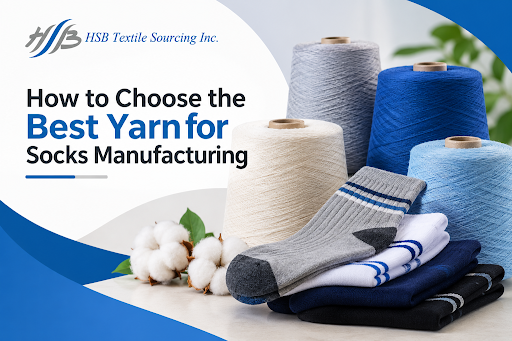
The yarn you choose can determine whether a sock feels soft and comfortable or loses its shape after only a few washes. For manufacturers, wholesalers, private-label brands and international buyers, selecting the right yarn is one of the most important decisions in the production process.
The best yarn for socks manufacturing depends on the type of sock, target customer, performance requirements and production budget. In this guide, we’ll cover the most suitable yarn options, sock yarn selection, quality checks, manufacturing considerations and how HSB Textile Sourcing Inc. can help buyers source the right materials and production partners in Pakistan.
Why Yarn Selection Matters in Sock Manufacturing
A sock must withstand stretching, friction, washing, moisture, and repeated use, so yarn selection directly affects comfort, durability, fit, and appearance. Poor yarn can cause pilling, fading, weak seams, and poor stretch recovery.
The best yarn depends on the sock’s intended use. Everyday cotton socks, sports socks, thermal socks, and work socks all require different yarn properties. Instead of asking for the “best yarn,” manufacturers should choose the right yarn for the specific sock and its performance requirements.
Understanding the Best Yarn Options for Socks
Different fibers offer different performance characteristics. Cotton, polyester, nylon, wool and blended yarns can all play an important role in commercial sock manufacturing.
Cotton Yarn for Socks
Cotton yarn for socks is a popular choice for everyday products because of its softness, breathability and comfortable feel. Cotton-rich socks are commonly suited to casual wear, school socks, lifestyle products and other applications where comfort is a priority.
However, cotton alone doesn’t provide the same level of stretch and recovery as elastane or some synthetic fibers. Manufacturers often combine cotton with other fibers to improve elasticity, durability and shape retention.
The quality of the cotton yarn also matters. Fiber characteristics, yarn construction, processing and consistency can influence how the finished sock looks and performs.
Polyester Yarn
Polyester is known for strength, durability, colour retention and resistance to repeated washing. It’s particularly useful for performance-oriented socks where durability and moisture management are important.
Modern polyester yarns can also be engineered for specific applications, making them useful in sports, athletic and activewear socks.
Wool and Merino Wool
Wool can be an excellent choice for winter, outdoor, hiking and thermal socks. It provides warmth while helping manage moisture, making it useful in products designed for colder conditions.
Merino wool is especially attractive for premium products because of its softer feel compared with many conventional wool types. However, its higher material cost means it needs to be matched with the right market position.
Blended Yarns
Blended yarns are often the most practical solution for commercial manufacturing because they allow manufacturers to combine the strengths of different fibers.
For example, a blend can combine:
- Cotton for softness and breathability
- Polyester for durability
- Nylon for abrasion resistance
- Elastane for stretch and recovery
- Wool for warmth and moisture management
HSB Textile Sourcing Inc. works with Pakistan’s textile and hosiery sector and lists pure cotton, mélange, mouliné, blended cotton and regenerated yarns among the yarn options used in its socks sourcing activities. Its socks operation also covers sports, dress, work, diabetic, children’s, thermal and other sock categories.
| Yarn Type | Key Benefit | Suitable Applications |
| Cotton | Softness and breathability | Everyday and casual socks |
| Polyester | Strength and durability | Sports and performance socks |
| Nylon | Abrasion resistance | Reinforced socks |
| Wool | Warmth and moisture management | Thermal and outdoor socks |
| Blended yarn | Balanced performance | Commercial and private-label socks |
Match the Yarn to the Type of Sock
The best sock yarn selection starts with the finished product. Before choosing a fiber, define how the sock will be used and what your customer expects from it.
Everyday and Casual Socks
Everyday socks usually need a practical balance between comfort, durability, breathability and price. Cotton-rich blends can work well because they provide a familiar hand feel while allowing manufacturers to add synthetic fibers for improved performance.
For mass-market products, the goal isn’t necessarily to use the most expensive fiber. It’s to select a consistent yarn that delivers the required performance at the target cost.
Sports and Athletic Socks
Sports socks face greater demands from movement, sweat, friction and frequent washing. Synthetic or blended yarns can be useful when the product needs improved durability, moisture management, drying performance and shape retention.
Yarn selection should also work alongside the sock’s construction. Mesh areas, cushioning, reinforced heels, and different knitting structures may require different material characteristics.
Children’s and School Socks
Children’s socks need softness, comfort, durability and good shape retention. Since these products may be washed frequently, the yarn should also be able to maintain its appearance and performance over repeated use.
For school and budget-focused products, a well-designed cotton blend can provide a practical balance between price and performance.
Key Factors for Evaluating Yarn Quality
Yarn quality for socks manufacturing should be evaluated before bulk production begins. A yarn may look attractive on a specification sheet but behave differently once it runs through the knitting process.
Fiber Quality
Ask where the fiber comes from and what grade is being supplied. For cotton, characteristics such as staple length, cleanliness, strength, and consistency can influence yarn performance.
Yarn Count
Yarn count affects thickness, weight, knitting behaviour and the appearance of the finished fabric. The appropriate count depends on the sock design, machine gauge, construction and desired weight.
Your supplier should recommend a suitable specification based on the actual sock rather than simply offering a commonly used count.
Stretch and Recovery
A sock needs to stretch comfortably over the foot and return toward its original shape. Fiber composition, elastane content, yarn characteristics and knitting construction all contribute to this performance.
Pilling Resistance
Pilling can quickly make a sock look worn. If appearance is important to your product, test the finished sock rather than relying solely on the yarn supplier’s description.
Colorfastness
For colored, branded, or patterned socks, colour performance is critical. Test the finished product for appropriate washing and rubbing performance based on the requirements of your target market.
How HSB Textile Sourcing Can Support Yarn Selection
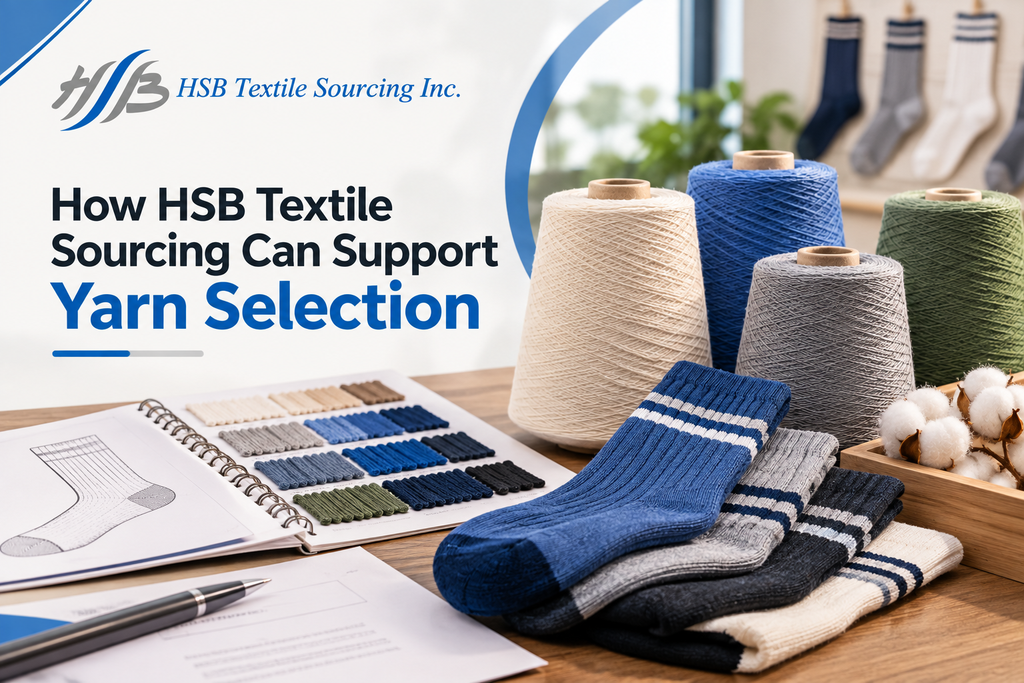
For overseas buyers, selecting the right yarn involves more than requesting a quotation. It may also require factory evaluation, sample development, specification matching, production monitoring, and quality inspection.
HSB Textile Sourcing Inc. provides sourcing and buying support for textile and hosiery products in Pakistan. Its services include factory evaluation, product development, price negotiation, production inspections, final reporting, and logistics coordination. This helps buyers ensure the right yarn specification is matched with the finished sock for quality, performance, and cost efficiency.
Test the Yarn Before Bulk Production
Never make a large yarn purchase based only on a supplier’s quotation or a photograph. Request samples and, where possible, test the material in the actual sock construction.
What to Check
Before approving the yarn, evaluate:
- Yarn appearance and evenness
- Fiber composition
- Yarn count
- Tensile strength
- Stretch and recovery
- Color consistency
- Pilling performance
- Knitting performance
- Finished sock comfort
- Washing performance
The most useful test is often the finished product. A yarn can perform well on its own but behave differently when knitted into a specific construction.
For larger orders, document the approved yarn specification and sample. This creates a reference point for future production and helps prevent unexpected substitutions.
How Yarn Choice Affects Manufacturing Costs
The cheapest yarn isn’t automatically the most economical option. A low-cost material can create additional expenses if it causes machine stoppages, knitting waste, inconsistent production, defects or customer complaints.
At the same time, using an unnecessarily expensive fiber can make a basic sock difficult to sell at its intended price.
The goal is to achieve the right cost-to-performance ratio.
| Product Requirement | Main Yarn Priority | Possible Yarn Direction |
| Everyday comfort | Softness and breathability | Cotton-rich blend |
| Sports performance | Durability and moisture management | Synthetic/performance blend |
| Winter warmth | Insulation | Wool or wool blend |
| Heavy use | Strength and abrasion resistance | Nylon/synthetic blend |
| Budget product | Cost and acceptable performance | Economical blend |
| Premium product | Comfort and performance | Specialized fiber blend |
Order quantity can also influence the final material cost. Larger, repeat orders may improve purchasing economics, but buyers shouldn’t increase volumes simply to obtain a lower unit price.
Your purchasing decision should consider realistic demand, storage, cash flow and the expected product life cycle.
Choose a Supplier That Understands the Finished Product
A good yarn supplier should provide technical information, consistent quality, samples and reliable communication. But for international sock buyers, the manufacturing partner is equally important.
Before committing to production, ask:
- What fiber compositions are available?
- Which yarn counts are suitable for my sock?
- Can you provide samples?
- What is the minimum order quantity?
- How do you maintain lot-to-lot consistency?
- Can you match specific colors?
- Can you develop custom sock samples?
- What production capacity is available?
- What inspection process is followed before shipment?
If you’re sourcing from Pakistan, working with an experienced sourcing company can simplify supplier evaluation and communication. HSB Textile Sourcing specifically provides factory evaluation, sample development, production coordination, inspection and shipment support for textile buyers.
Build Your Yarn Specification Around the Final Sock
The best approach is to start with the finished sock and target customer. Define the sock category, price, comfort, durability, and design requirements, then choose the right fiber blend, yarn count, knitting construction, and finishing.
This helps avoid choosing yarn based only on perceived quality. A premium sports sock may need performance yarn, while an everyday sock can deliver better value with a well-selected cotton blend.
Final Thoughts
Choosing the best yarn for socks manufacturing depends on the sock’s intended use, comfort requirements, durability, construction, production process, and target price. Cotton, polyester, nylon, wool, and blended yarns each offer different performance benefits, making yarn selection an important part of developing quality socks for specific markets.
For businesses sourcing socks from Pakistan, HSB Textile Sourcing Inc. supports supplier evaluation, yarn and product development, sampling, price negotiation, production monitoring, quality inspection, and logistics. Whether you are developing a private-label collection or a new sock range, HSB Textile Sourcing can help you select the right yarn and manufacturing solution for your target market. Contact HSB Textile Sourcing to discuss your sock requirements.
FAQs
What is the best yarn for socks manufacturing?
There isn’t one universal yarn that works best for every sock. Cotton, polyester, nylon, wool, and blended yarns can all be suitable depending on comfort, durability, stretch, warmth, performance and target cost.
Is cotton yarn good for socks?
Yes, cotton is widely used for socks because it’s soft, breathable and comfortable for everyday wear. Cotton is often blended with elastane or synthetic fibers to improve stretch, recovery and durability.
What is the best yarn for sports socks?
Performance-oriented synthetic yarns and blends can be suitable for sports socks because they can provide durability, moisture management and quick-drying performance. The final choice should also consider the knitting structure and intended activity.
How do you check yarn quality for socks manufacturing?
Manufacturers can evaluate fiber composition, yarn count, evenness, strength, stretch, color consistency and knitting performance. Testing the yarn in the actual sock construction is particularly useful before approving bulk production.