
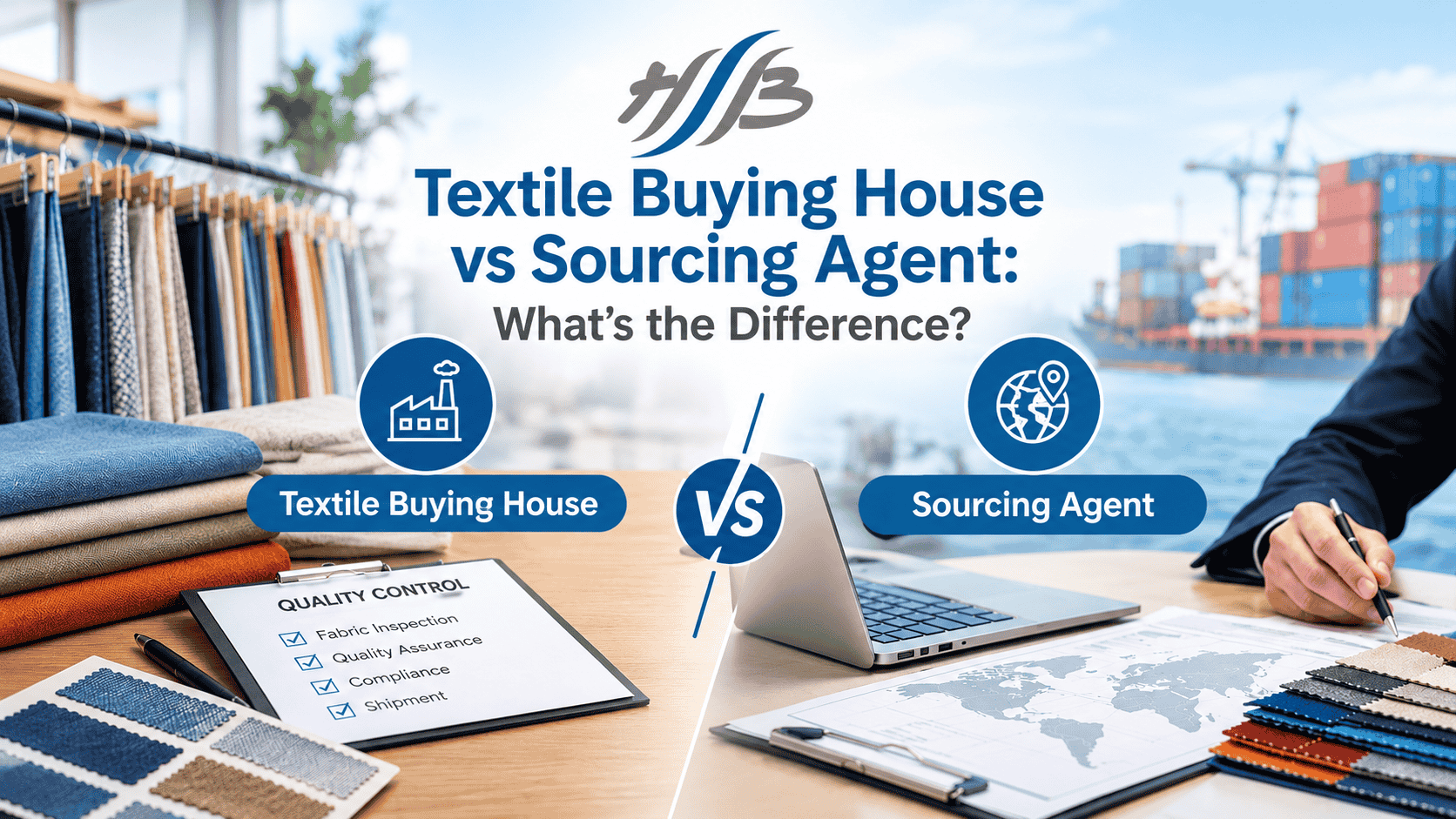
Textile Buying House vs Sourcing Agent: What’s the Difference?
If you want to buy fabric or garments from overseas, you will soon hear two terms: textile buying house and sourcing agent. Many people think they mean the same thing. They are close, but they are not identical. Choosing the wrong one can cost you time and money. It can also lead to late orders and poor quality. This article explains the difference in simple words so you can pick the right partner for your business. What Is a Textile Buying House? A textile buying house is a company that works for international buyers. These buyers can be clothing brands, retailers, importers, or wholesalers. The buying house finds factories, manages orders, and makes sure the goods arrive on time. Most buying houses are based in countries that make a lot of textiles, such as Pakistan, Bangladesh, India, and China. They know the local factories well. They also know the local rules, prices, and shipping routes. A buying house usually offers a full service. This often includes: Think of a buying house as your office in another country. It acts like your own team on the ground, even if you never set foot there. For example, HSB Textile Sourcing is a buying house in Lahore, Pakistan. It offers sourcing, merchandising, and quality control for overseas buyers. You can see the full list on its textile sourcing services page. What Is a Sourcing Agent? A sourcing agent is a person or a small company that helps you find suppliers. Their main job is to connect you with the right factory for your product. Many sourcing agents work alone or with a small team. Some focus on one product, like cotton fabric or knitwear. Others focus on one region or one country. A sourcing agent often helps with: Some sourcing agents do more than this, but many stop once the deal is made between you and the factory. After that, you handle most of the work yourself. The Main Differences at a Glance 1. Size and structure A buying house is usually a registered company with many staff members. These may include merchandisers, quality controllers, and shipping experts. A sourcing agent is often one person or a small team. 2. Range of services A buying house handles the whole process, from the first sample to the final delivery. A sourcing agent mostly helps with finding suppliers and starting the deal. 3. Order management Buying a house tracks your order day by day. It follows up with the factory and solves problems fast. A sourcing agent may check in now and then, but your own team often has to do the follow-up. 4. Quality control Most buying houses have their own quality control team. They check goods during production and before shipping. Many sourcing agents do not have a full team for this, so you may need to hire a third-party inspector. 5. Cost structure A buying house often charges a commission, usually a percentage of the order value. A sourcing agent may charge a fixed fee, a commission, or an hourly rate. 6. Responsibility Buying a house is often more responsible for the final result. If something goes wrong, you have a clear company to talk to. With a lone sourcing agent, the risk can be higher because they may have less to lose. Pros and Cons of a Textile Buying House Pros Cons Pros and Cons of a Sourcing Agent Pros Cons Tips for Choosing a Good Partner Common Mistakes to Avoid Final Thoughts A textile buying house and a sourcing agent both help you buy from overseas, but they do not offer the same level of service. A buying house gives you a full team and handles your order from start to finish. A sourcing agent mainly helps you find the right supplier. If your orders are big and regular, a buying house is usually the safer choice. If you are small or just starting, a sourcing agent can be a smart and low-cost way to begin. Whatever you choose, check their record, ask clear questions, and start small. Ready to talk about your next order? Visit HSB Textile Sourcing to learn more, or read the latest posts on the HSB blog. Frequently Asked Questions (FAQs) Is a textile buying house the same as a sourcing agent? No. A buying house is usually a bigger company that manages the whole order, from samples to shipping. A sourcing agent mainly helps you find a supplier and start the deal. Which is cheaper, a buying house or a sourcing agent? A sourcing agent can look cheaper for small jobs. But a buying house often includes inspections, follow-ups, and shipping help in its fee. Compare the total cost, not just the headline price. Do buying houses work with small orders? Some do, and some set a minimum order size. It is best to ask before you start. You can contact HSB Textile Sourcing to talk about your order size. What does a textile buying house do for quality control? It checks goods while they are being made and again before shipping. This helps catch problems early, before the goods leave the factory. What products can I source from Pakistan? Common choices include socks, apparel, towels, bed sheets, denim, medical items, and cotton yarn. You can browse the full products list to see what is available. Can I use a sourcing agent first and buy a house later? Yes. Many businesses do this. They use a sourcing agent to find options, then move to a buying house when their orders grow and they need more support.
Read More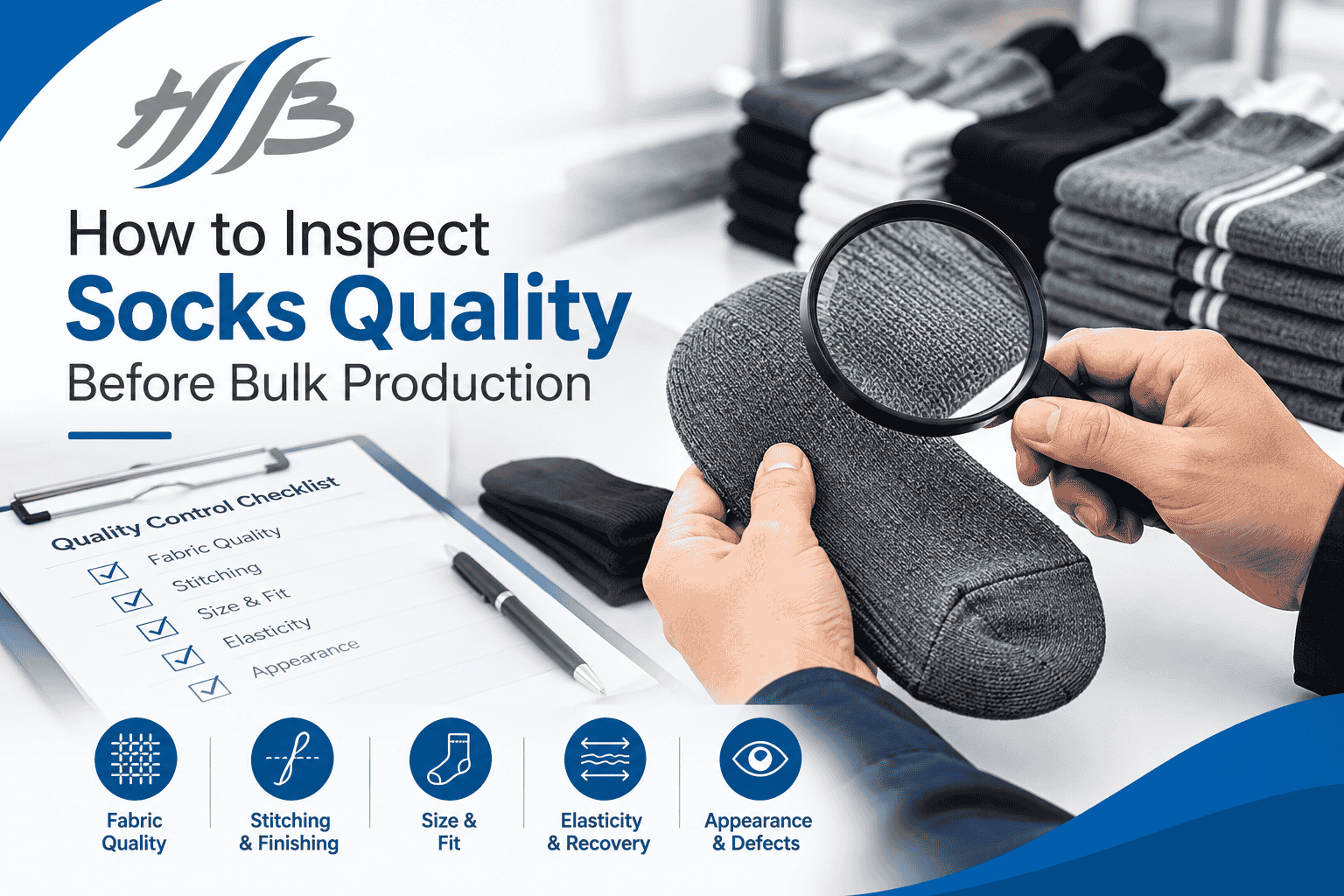
How to Inspect Socks Quality Before Bulk Production
Bulk sock orders fail for boring, preventable reasons: a yarn substitution nobody approved, a cuff that loses recovery after three washes, or sizes that drift half an inch between knitting machines. By the time 40,000 pairs are cartoned and sealed, your options are bad ones: accept the lot, negotiate a discount, or fight for a rework that blows your delivery window. Knowing how to inspect socks quality before bulk production helps buyers catch manufacturing defects, material inconsistencies, and sizing problems before they become expensive mistakes. Socks quality inspection is cheapest and most effective before the bulk run starts. This guide walks through the pre-production sock quality control checklist buyers should follow, from yarn verification and pre-production sample approval to AQL inspection standards and packaging checks, so what ships matches what you approved. Why Pre-Production Inspection Matters More for Socks Socks are circular-knitted, not cut-and-sewn, which changes the risk profile. There’s no cutting table to catch fabric faults, and a single mis-set needle can repeat the same defect across thousands of pairs before anyone notices. Elastane behavior, dye lot consistency, and toe-closure quality are all influenced by production setup. When buyers inspect socks quality before manufacturing begins, they can identify material inconsistencies, incorrect measurements, stitching defects, and potential durability problems before committing to a large order. That’s why serious buyers treat pre-production as a critical inspection point. Once you’ve committed to a machine setup and a yarn lot, a quality-controlled sourcing process is what separates a clean shipment from a claim. Step 1: Verify Yarn and Raw Material Before Knitting Starts Everything downstream depends on the yarn. Before the factory loads machines, confirm: Buyers sourcing from South Asia often verify spinning quality separately. HSB works directly with cotton yarn suppliers in Pakistan, which makes upstream verification easier than tracing yarn through multiple middlemen. Step 2: Approve the Pre-Production Sample (PPS) Properly The pre-production sample is your contract. It must be knitted on the same machine type, with the same yarn lot, in the same factory that will run bulk not a showroom sample from a different facility. Check the PPS against: Parameter What to verify Gauge & needle count Matches approved construction (e.g. 144N, 200N) Weight per pair Within ±5% of approved gram weight Size & measurements Length, foot length, leg height, cuff width Cuff recovery Stretch and release 10x measure return to original Toe closure Linked (flat, smooth) vs. rosso/overlock seam Terry pile height For cushioned or sports socks Logo & jacquard clarity No distortion when stretched on a leg form Sign off the PPS in writing, with photos, and keep a sealed counter-sample. Every later dispute gets resolved against that sealed pair. Step 3: Run Lab Tests Before Committing to Bulk A sock can look perfect and still fail in a consumer’s washing machine. Request third-party or in-house lab testing on the PPS: Testing the PPS costs a few hundred dollars. Testing after bulk costs you the order. Step 4: Inline Inspection During Knitting Don’t wait for the final inspection. Schedule an inline check when roughly 15–20% of the order is knitted. At that point you can still correct machine settings without scrapping much output. Inline sock inspection looks for: This is where having someone physically on the factory floor matters. Remote buyers relying on WhatsApp photos see what the factory chooses to photograph. Step 5: Final Random Inspection Using AQL Standards The final pre-shipment inspection follows ISO 2859-1 (ANSI/ASQC Z1.4) sampling. For socks, most buyers apply AQL 2.5 for major defects and 4.0 for minor defects at General Inspection Level II. Typical classification: Critical foreign objects (needles, metal), wrong composition labeling, safety hazards on children’s socks. Zero tolerance. Major holes, broken stitches, wrong size, off-shade, missing or incorrect logo, poor toe closure, measurements outside tolerance, mismatched pairs. Minor small loose threads, slight yarn knots, minor label misalignment, light soiling that washes out. Inspect a genuine random sample pulled from sealed cartons across the lot not a tray the factory prepared. Turn socks inside out; most stitching defects hide on the reverse. Step 6: Packaging, Labeling and Carton Checks Buyers lose money at customs for reasons that have nothing to do with knitting quality: A 45-day ocean transit in a humid container can mildew socks that left the factory clean. Desiccant and proper carton sealing belong in your inspection scope. Common Mistakes Buyers Make For a broader view of factory selection, MOQs and lead times, see our 2026 guide to sourcing socks from Pakistan. Final Thought Most overseas buyers can’t fly to Lahore or Faisalabad for every inline check. A local sourcing and QC partner gives you factory audits, sample verification, in-line monitoring, and independent AQL pre-shipment inspection with photo reports before goods leave the floor. HSB Textile Sourcing has worked in socks manufacturing and sourcing for over 30 years, applying 4-point fabric inspection and AQL 2.5/4.0 sampling across every production lot. Learn more about our team or request a quality-controlled quote. FAQs: Socks Quality Inspection When should I inspect socks before bulk production? At three points: yarn approval before knitting, pre-production sample approval, and an inline check at 15–20% completion. Final pre-shipment AQL inspection confirms the lot but is too late to fix systemic defects. What AQL level should I use for socks? AQL 2.5 for major defects and 4.0 for minor defects at General Inspection Level II is the standard for most sock categories. Premium, medical, and infant socks often tighten to AQL 1.5. What are the most common sock defects? Holes, dropped stitches, needle lines, barré shading, poor toe closure, weak cuff recovery, size variance between machines, and off-shade pairs. How do I test if a sock cuff will lose its shape? Stretch and release the cuff 10–15 times and measure return to original width, then repeat after 3–5 wash cycles. Poor recovery usually traces to low-quality covered elastane. Can I rely on the factory’s own inspection report? Factory QC is useful but not independent. Buyers should use a third-party or sourcing-agent inspection with a
Read More
How to Import Socks From Pakistan: A Step-by-Step Guide
Importing socks from Pakistan can be a practical opportunity for retailers, wholesalers, private-label brands and e-commerce businesses looking for competitive textile sourcing options. But successful importing involves much more than finding a manufacturer and agreeing on a price. You need to select the right sock type, verify suppliers, approve samples, understand pricing, establish quality standards, arrange shipping and prepare the necessary import documentation. In this guide, we’ll walk through the complete process of importing socks from Pakistan, with practical advice for both first-time and experienced buyers. Why Import Socks From Pakistan? Pakistan has a well-established textile and hosiery industry supported by cotton production, yarn manufacturing, knitting, dyeing, finishing and garment production. This gives international buyers access to a broad supply chain when sourcing socks and other textile products. For buyers, sourcing from Pakistan can offer several potential advantages: However, the lowest factory price shouldn’t be your only consideration. Consistent quality, communication, production capacity, lead times and shipping arrangements can have a much greater impact on your total importing experience. Step 1: Define Your Sock Product Requirements Before contacting suppliers, create a clear product specification. A manufacturer can’t provide an accurate quotation or produce a consistent product if important details are missing. Start by deciding exactly what you want to import. Define the Sock Type Depending on your target market, you may need: Include Product Details Your specification should also include: A detailed specification reduces misunderstandings and makes it much easier to compare quotations from different suppliers. Step 2: Find Reliable Sock Suppliers in Pakistan Once your requirements are ready, create a shortlist of potential sock suppliers in Pakistan. Look beyond online listings and evaluate each supplier based on their manufacturing experience, product specialization, capacity, quality systems, and ability to meet your specific requirements. What to Check Before selecting a supplier, consider: Where possible, request product samples, company information, factory photos or videos, certifications, and relevant references before moving forward with a supplier. Consider a Textile Sourcing Partner International buyers may not have the resources to evaluate factories directly in Pakistan. A reliable sourcing partner can help identify suitable manufacturers, coordinate communication, and manage the purchasing process locally. HSB Textile Sourcing Inc. supports overseas buyers with factory evaluation, product and sample development, price negotiation, production planning, quality inspections, reporting, and logistics coordination. With experience in Pakistan’s textile and hosiery sector, HSB helps make sourcing socks and other textile products easier for buyers without a local purchasing team. Step 3: Request Quotations and Compare Suppliers After creating your supplier shortlist, send the same product specification to each company. This is important because comparing different specifications can make one supplier appear cheaper even when the products aren’t equivalent. Ask suppliers to provide: Don’t Choose the Cheapest Quote Automatically A low quotation may reflect differences in yarn quality, construction, packaging, labour, testing or other specifications. Instead, compare the total value of each offer. Factor What to Compare Unit price Cost per pair based on the same specification MOQ Minimum quantity required Material Fiber composition and yarn quality Sampling Cost and development timeline Production Capacity and expected lead time Quality control Inspection process and standards Packaging Retail or bulk packaging requirements Shipping Incoterm and freight arrangements Payment Deposit and balance terms The goal is to identify the supplier that can consistently deliver the required product at a commercially sensible cost. Step 4: Order and Approve Samples Never move directly from quotation to a large production order without approving a sample. The sample gives you an opportunity to confirm whether the supplier understands your requirements. Inspect the Sample Carefully Check: If you provide the supplier with a physical reference sample, compare the factory’s sample directly against it. Don’t approve a sample verbally. Keep a record of the final specifications and approved version so there’s a clear reference during bulk production. Step 5: Confirm Quality Standards Before Production Quality problems are much easier to prevent than to correct after a container has left Pakistan. Before production begins, establish measurable quality requirements. Your specifications can cover: Step 6: Finalize Pricing and Payment Terms Once your sample and specifications are approved, negotiate the final commercial terms. Your purchase agreement should clearly state: Step 7: Arrange Production and Monitor Progress After the order is confirmed, production begins. Don’t simply wait until the expected shipping date to ask about progress. Regular communication can help identify problems early. Track: For international buyers, having someone locally monitor production can reduce communication delays and provide better visibility into the order. Step 8: Prepare Shipping and Export Documents Once production is completed and the goods pass inspection, the shipment needs to be prepared. Depending on the transaction and destination, commonly required documents may include: Exact requirements depend on the importing country, product classification, shipping method and applicable regulations. Step 9: Handle Customs and Import Requirements This is where buyers need to pay particular attention. Your socks will need an appropriate customs classification and the importing country may apply duties, taxes, labeling rules, testing requirements or other regulations. Before placing the order, check the requirements with your country’s customs authority or a qualified customs broker. Your Import Cost Is More Than the Factory Price Your landed cost may include: Understanding the complete landed cost helps you determine whether the product will actually be profitable in your market. Why Work With HSB Textile Sourcing? Importing socks from Pakistan can involve managing suppliers, samples, production, inspections, shipping, and documentation from overseas. This can make the sourcing process challenging without reliable local support. HSB Textile Sourcing Inc. provides sourcing and buying-house support, including factory evaluation, product development, sample coordination, price negotiation, production monitoring, quality inspection, reporting, and logistics. The company also supports other textile categories, helping buyers coordinate socks, apparel, towels, bed sheets, cotton yarn, denim, and more through one sourcing partner. Final Thoughts Learning how to import socks from Pakistan starts with a clear sourcing process. Define your product specifications, evaluate suppliers, compare quotations, approve samples, set quality standards, monitor production, and calculate the complete landed cost
Read More
How to Choose the Best Yarn for Socks Manufacturing
The yarn you choose can determine whether a sock feels soft and comfortable or loses its shape after only a few washes. For manufacturers, wholesalers, private-label brands and international buyers, selecting the right yarn is one of the most important decisions in the production process. The best yarn for socks manufacturing depends on the type of sock, target customer, performance requirements and production budget. In this guide, we’ll cover the most suitable yarn options, sock yarn selection, quality checks, manufacturing considerations and how HSB Textile Sourcing Inc. can help buyers source the right materials and production partners in Pakistan. Why Yarn Selection Matters in Sock Manufacturing A sock must withstand stretching, friction, washing, moisture, and repeated use, so yarn selection directly affects comfort, durability, fit, and appearance. Poor yarn can cause pilling, fading, weak seams, and poor stretch recovery. The best yarn depends on the sock’s intended use. Everyday cotton socks, sports socks, thermal socks, and work socks all require different yarn properties. Instead of asking for the “best yarn,” manufacturers should choose the right yarn for the specific sock and its performance requirements. Understanding the Best Yarn Options for Socks Different fibers offer different performance characteristics. Cotton, polyester, nylon, wool and blended yarns can all play an important role in commercial sock manufacturing. Cotton Yarn for Socks Cotton yarn for socks is a popular choice for everyday products because of its softness, breathability and comfortable feel. Cotton-rich socks are commonly suited to casual wear, school socks, lifestyle products and other applications where comfort is a priority. However, cotton alone doesn’t provide the same level of stretch and recovery as elastane or some synthetic fibers. Manufacturers often combine cotton with other fibers to improve elasticity, durability and shape retention. The quality of the cotton yarn also matters. Fiber characteristics, yarn construction, processing and consistency can influence how the finished sock looks and performs. Polyester Yarn Polyester is known for strength, durability, colour retention and resistance to repeated washing. It’s particularly useful for performance-oriented socks where durability and moisture management are important. Modern polyester yarns can also be engineered for specific applications, making them useful in sports, athletic and activewear socks. Wool and Merino Wool Wool can be an excellent choice for winter, outdoor, hiking and thermal socks. It provides warmth while helping manage moisture, making it useful in products designed for colder conditions. Merino wool is especially attractive for premium products because of its softer feel compared with many conventional wool types. However, its higher material cost means it needs to be matched with the right market position. Blended Yarns Blended yarns are often the most practical solution for commercial manufacturing because they allow manufacturers to combine the strengths of different fibers. For example, a blend can combine: HSB Textile Sourcing Inc. works with Pakistan’s textile and hosiery sector and lists pure cotton, mélange, mouliné, blended cotton and regenerated yarns among the yarn options used in its socks sourcing activities. Its socks operation also covers sports, dress, work, diabetic, children’s, thermal and other sock categories. Yarn Type Key Benefit Suitable Applications Cotton Softness and breathability Everyday and casual socks Polyester Strength and durability Sports and performance socks Nylon Abrasion resistance Reinforced socks Wool Warmth and moisture management Thermal and outdoor socks Blended yarn Balanced performance Commercial and private-label socks Match the Yarn to the Type of Sock The best sock yarn selection starts with the finished product. Before choosing a fiber, define how the sock will be used and what your customer expects from it. Everyday and Casual Socks Everyday socks usually need a practical balance between comfort, durability, breathability and price. Cotton-rich blends can work well because they provide a familiar hand feel while allowing manufacturers to add synthetic fibers for improved performance. For mass-market products, the goal isn’t necessarily to use the most expensive fiber. It’s to select a consistent yarn that delivers the required performance at the target cost. Sports and Athletic Socks Sports socks face greater demands from movement, sweat, friction and frequent washing. Synthetic or blended yarns can be useful when the product needs improved durability, moisture management, drying performance and shape retention. Yarn selection should also work alongside the sock’s construction. Mesh areas, cushioning, reinforced heels, and different knitting structures may require different material characteristics. Children’s and School Socks Children’s socks need softness, comfort, durability and good shape retention. Since these products may be washed frequently, the yarn should also be able to maintain its appearance and performance over repeated use. For school and budget-focused products, a well-designed cotton blend can provide a practical balance between price and performance. Key Factors for Evaluating Yarn Quality Yarn quality for socks manufacturing should be evaluated before bulk production begins. A yarn may look attractive on a specification sheet but behave differently once it runs through the knitting process. Fiber Quality Ask where the fiber comes from and what grade is being supplied. For cotton, characteristics such as staple length, cleanliness, strength, and consistency can influence yarn performance. Yarn Count Yarn count affects thickness, weight, knitting behaviour and the appearance of the finished fabric. The appropriate count depends on the sock design, machine gauge, construction and desired weight. Your supplier should recommend a suitable specification based on the actual sock rather than simply offering a commonly used count. Stretch and Recovery A sock needs to stretch comfortably over the foot and return toward its original shape. Fiber composition, elastane content, yarn characteristics and knitting construction all contribute to this performance. Pilling Resistance Pilling can quickly make a sock look worn. If appearance is important to your product, test the finished sock rather than relying solely on the yarn supplier’s description. Colorfastness For colored, branded, or patterned socks, colour performance is critical. Test the finished product for appropriate washing and rubbing performance based on the requirements of your target market. How HSB Textile Sourcing Can Support Yarn Selection For overseas buyers, selecting the right yarn involves more than requesting a quotation. It may also require factory evaluation,
Read More
How to Source Socks From Pakistan: 2026 Buyer’s Guide
Sourcing socks from Pakistan can give brands, retailers, wholesalers and private-label businesses access to an established textile and hosiery manufacturing base. But choosing the right supplier takes more than comparing a few quotations. From product specifications and yarn selection to sampling, quality control, pricing and shipping, every stage can affect your final cost and customer satisfaction. This guide explains how to source socks from Pakistan, what to ask suppliers and how to avoid common buying mistakes. Why Source Socks From Pakistan? Pakistan has a well-developed textile and hosiery industry supported by cotton production, yarn manufacturing, knitting, dyeing, finishing and garment production. Government trade directories also list Pakistani exporters specifically operating in socks, hosiery, knitted garments and related textile categories. Faisalabad is particularly important for textile sourcing, with exporters and manufacturers covering socks, hosiery, knitted garments, yarn, towels and other textile products. The Trade Development Authority of Pakistan’s exporter listings include several Faisalabad businesses categorized for socks and hosiery products. For international buyers, the main advantages can include: Pakistan’s textile ecosystem also makes it possible to source related products through the same supply network. That can be useful if your business needs socks alongside apparel, towels, knitwear or other textile products. What Types of Socks Can You Source From Pakistan? Before contacting manufacturers, define exactly what you need. “Socks” is too broad for an accurate quotation because the manufacturing process and material requirements vary considerably by product. Common Sock Categories You may be able to source: The right specification depends on your target market and intended use. For example, sports socks may require moisture-management yarns and cushioning, while everyday cotton socks may focus more heavily on comfort, softness, durability and cost. Compare Your Product Requirements First Requirement What the Buyer Should Specify Material Cotton, polyester, nylon, spandex, blends, etc. Sock type Crew, ankle, sports, thermal, fashion, etc. Size Adult, children’s or custom size range Design Plain, jacquard, logo, stripes, patterns Construction Knit structure, cushioning, rib, mesh, etc. Packaging Individual polybag, carton, branded packaging Quantity Expected order quantity and repeat volume Branding Logo, label, packaging and private-label requirements The more complete your specification sheet is, the easier it is for a Pakistani supplier to provide a meaningful quotation. How to Find a Reliable Pakistani Sock Supplier Finding a supplier is only the first step. Your real objective should be finding a manufacturer that can consistently meet your specifications, quality standards, production schedule and communication requirements. Start by creating a shortlist of manufacturers or sourcing companies with relevant experience. Trade directories can be useful for verifying that companies operate within Pakistan’s textile and hosiery export sector. For example, official trade listings include exporters categorized specifically under socks and hosiery. Check These Points Before Ordering Ask potential suppliers about: Don’t select a supplier simply because its first quotation is the cheapest. A lower unit price can become expensive if you receive inconsistent sizing, poor stitching, incorrect colours, late shipments or excessive defects. Understand Sock Manufacturing Costs One of the first questions buyers usually ask is about sock manufacturing costs. There isn’t one standard price because the final cost depends on several variables. Material is one of the biggest factors. A basic cotton-blend sock and a technically engineered sports sock can have very different costs even when both are sold as “socks.” Other cost drivers include: Why Quantity Matters Larger production runs can often produce better unit economics because setup, sampling, packaging and other fixed costs are distributed across more pairs. However, don’t increase your order simply to obtain a lower quoted price. Your purchasing volume should match realistic demand, storage capacity, cash flow and expected sales. Cost Factor Lower-Cost Scenario Higher-Cost Scenario Material Standard blend Specialized or high-performance yarn Design Simple/plain Complex multi-colour design Branding Basic label Custom labels and packaging Construction Standard knit Cushioning/reinforcement/special structures Quantity Larger repeat order Small production run Packaging Standard bulk packing Individual retail packaging Testing Standard requirements Extensive testing/compliance For an accurate quotation, send suppliers the same specification and quantity so you’re comparing like-for-like offers. Sampling and Quality Control Before Bulk Production A sample should never be treated as a formality. It is your opportunity to check whether the supplier understands the product before committing to a larger order. Review the sample for: For larger orders, consider establishing written quality standards before production begins. Your purchase specification should clearly define acceptable measurements, colors, materials, workmanship, packaging and defect tolerance. A professional sourcing partner can also coordinate factory communication and quality checks, which is particularly useful when the buyer isn’t located in Pakistan. Plan Shipping, Documentation and Lead Times Even when manufacturing goes smoothly, poor logistics planning can delay an order. Before placing the purchase order, confirm: Build some buffer into your schedule rather than planning around the earliest possible shipment date. International buyers should also confirm their country’s import requirements before production begins. A sourcing company can add value here by coordinating communication between the buyer, manufacturer, inspection team and logistics providers. Common Mistakes Buyers Make When Sourcing Socks Many sourcing problems are avoidable. Choosing Only on Price The cheapest quotation isn’t necessarily the best deal. Compare material quality, construction, packaging, production capability, inspection procedures and lead time alongside the unit price. Sending an Incomplete Specification A supplier can’t accurately price or reproduce a product when essential details are missing. Provide measurements, materials, designs, quantities, packaging requirements and branding information upfront. Skipping Samples Never assume that a factory can reproduce your reference product perfectly without testing. Approve a production sample before bulk manufacturing. Not Defining Quality Standards Terms like “good quality” mean different things to different people. Use measurable requirements wherever possible. Waiting Until Production to Discuss Problems If something is wrong with the sample, resolve it before bulk production. Correcting a specification early is far easier than dealing with thousands of finished pairs. A Practical Sourcing Process For beginners and experienced buyers alike, a structured process reduces unnecessary risk: This process gives buyers much more control than simply sending a product picture and asking, “What’s your
Read More