
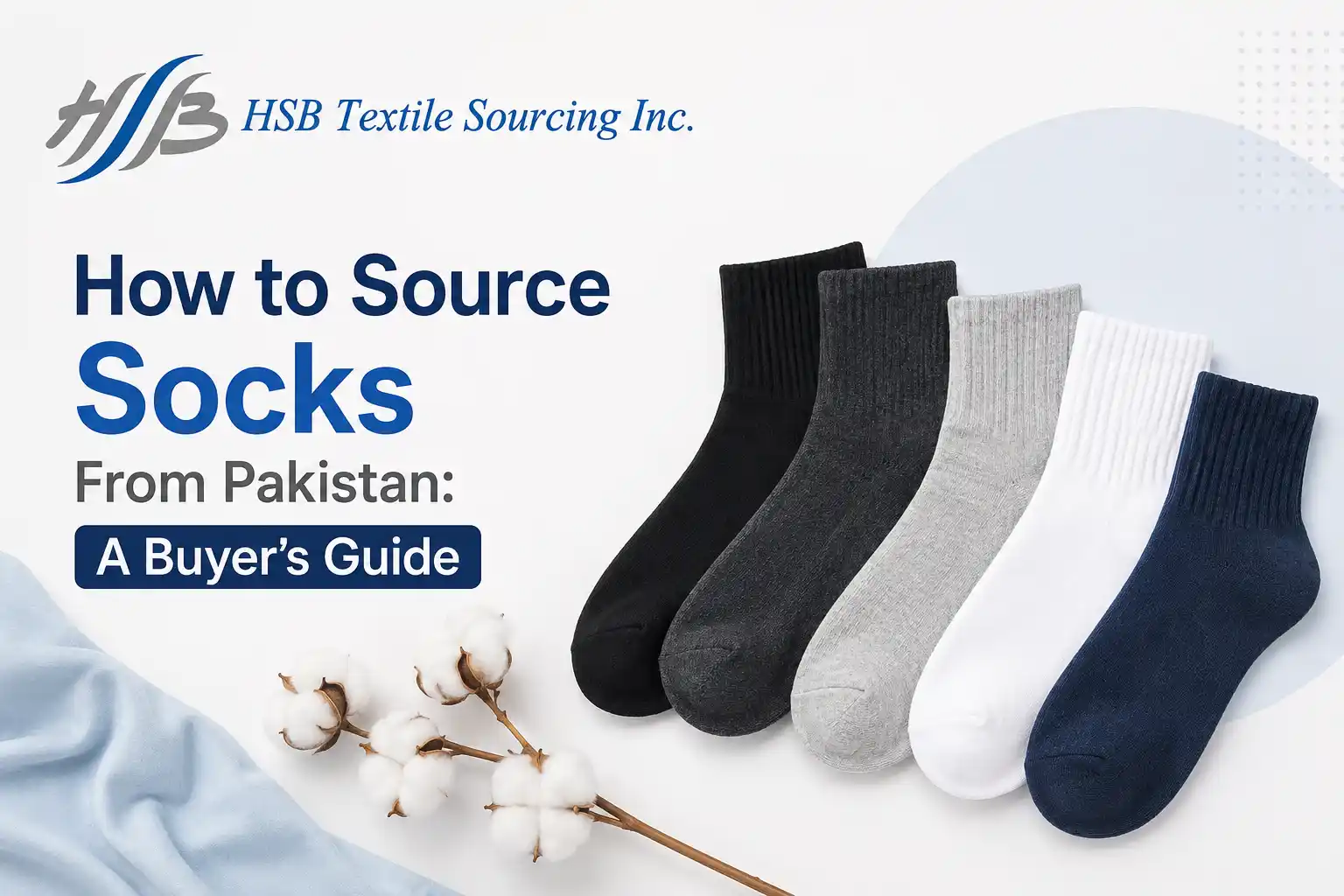
How to Source Socks From Pakistan: 2026 Buyer’s Guide
Sourcing socks from Pakistan can give brands, retailers, wholesalers and private-label businesses access to an established textile and hosiery manufacturing base. But choosing the right supplier takes more than comparing a few quotations. From product specifications and yarn selection to sampling, quality control, pricing and shipping, every stage can affect your final cost and customer satisfaction. This guide explains how to source socks from Pakistan, what to ask suppliers and how to avoid common buying mistakes. Why Source Socks From Pakistan? Pakistan has a well-developed textile and hosiery industry supported by cotton production, yarn manufacturing, knitting, dyeing, finishing and garment production. Government trade directories also list Pakistani exporters specifically operating in socks, hosiery, knitted garments and related textile categories. Faisalabad is particularly important for textile sourcing, with exporters and manufacturers covering socks, hosiery, knitted garments, yarn, towels and other textile products. The Trade Development Authority of Pakistan’s exporter listings include several Faisalabad businesses categorized for socks and hosiery products. For international buyers, the main advantages can include: Pakistan’s textile ecosystem also makes it possible to source related products through the same supply network. That can be useful if your business needs socks alongside apparel, towels, knitwear or other textile products. What Types of Socks Can You Source From Pakistan? Before contacting manufacturers, define exactly what you need. “Socks” is too broad for an accurate quotation because the manufacturing process and material requirements vary considerably by product. Common Sock Categories You may be able to source: The right specification depends on your target market and intended use. For example, sports socks may require moisture-management yarns and cushioning, while everyday cotton socks may focus more heavily on comfort, softness, durability and cost. Compare Your Product Requirements First Requirement What the Buyer Should Specify Material Cotton, polyester, nylon, spandex, blends, etc. Sock type Crew, ankle, sports, thermal, fashion, etc. Size Adult, children’s or custom size range Design Plain, jacquard, logo, stripes, patterns Construction Knit structure, cushioning, rib, mesh, etc. Packaging Individual polybag, carton, branded packaging Quantity Expected order quantity and repeat volume Branding Logo, label, packaging and private-label requirements The more complete your specification sheet is, the easier it is for a Pakistani supplier to provide a meaningful quotation. How to Find a Reliable Pakistani Sock Supplier Finding a supplier is only the first step. Your real objective should be finding a manufacturer that can consistently meet your specifications, quality standards, production schedule and communication requirements. Start by creating a shortlist of manufacturers or sourcing companies with relevant experience. Trade directories can be useful for verifying that companies operate within Pakistan’s textile and hosiery export sector. For example, official trade listings include exporters categorized specifically under socks and hosiery. Check These Points Before Ordering Ask potential suppliers about: Don’t select a supplier simply because its first quotation is the cheapest. A lower unit price can become expensive if you receive inconsistent sizing, poor stitching, incorrect colours, late shipments or excessive defects. Understand Sock Manufacturing Costs One of the first questions buyers usually ask is about sock manufacturing costs. There isn’t one standard price because the final cost depends on several variables. Material is one of the biggest factors. A basic cotton-blend sock and a technically engineered sports sock can have very different costs even when both are sold as “socks.” Other cost drivers include: Why Quantity Matters Larger production runs can often produce better unit economics because setup, sampling, packaging and other fixed costs are distributed across more pairs. However, don’t increase your order simply to obtain a lower quoted price. Your purchasing volume should match realistic demand, storage capacity, cash flow and expected sales. Cost Factor Lower-Cost Scenario Higher-Cost Scenario Material Standard blend Specialized or high-performance yarn Design Simple/plain Complex multi-colour design Branding Basic label Custom labels and packaging Construction Standard knit Cushioning/reinforcement/special structures Quantity Larger repeat order Small production run Packaging Standard bulk packing Individual retail packaging Testing Standard requirements Extensive testing/compliance For an accurate quotation, send suppliers the same specification and quantity so you’re comparing like-for-like offers. Sampling and Quality Control Before Bulk Production A sample should never be treated as a formality. It is your opportunity to check whether the supplier understands the product before committing to a larger order. Review the sample for: For larger orders, consider establishing written quality standards before production begins. Your purchase specification should clearly define acceptable measurements, colors, materials, workmanship, packaging and defect tolerance. A professional sourcing partner can also coordinate factory communication and quality checks, which is particularly useful when the buyer isn’t located in Pakistan. Plan Shipping, Documentation and Lead Times Even when manufacturing goes smoothly, poor logistics planning can delay an order. Before placing the purchase order, confirm: Build some buffer into your schedule rather than planning around the earliest possible shipment date. International buyers should also confirm their country’s import requirements before production begins. A sourcing company can add value here by coordinating communication between the buyer, manufacturer, inspection team and logistics providers. Common Mistakes Buyers Make When Sourcing Socks Many sourcing problems are avoidable. Choosing Only on Price The cheapest quotation isn’t necessarily the best deal. Compare material quality, construction, packaging, production capability, inspection procedures and lead time alongside the unit price. Sending an Incomplete Specification A supplier can’t accurately price or reproduce a product when essential details are missing. Provide measurements, materials, designs, quantities, packaging requirements and branding information upfront. Skipping Samples Never assume that a factory can reproduce your reference product perfectly without testing. Approve a production sample before bulk manufacturing. Not Defining Quality Standards Terms like “good quality” mean different things to different people. Use measurable requirements wherever possible. Waiting Until Production to Discuss Problems If something is wrong with the sample, resolve it before bulk production. Correcting a specification early is far easier than dealing with thousands of finished pairs. A Practical Sourcing Process For beginners and experienced buyers alike, a structured process reduces unnecessary risk: This process gives buyers much more control than simply sending a product picture and asking, “What’s your
Read More